Our Project
Mary Ann Canyon
A comprehensive look at the geology, claims, sampling data, and mineral potential of the Osceola Mining District's most promising area.
Location & Access
Project Overview
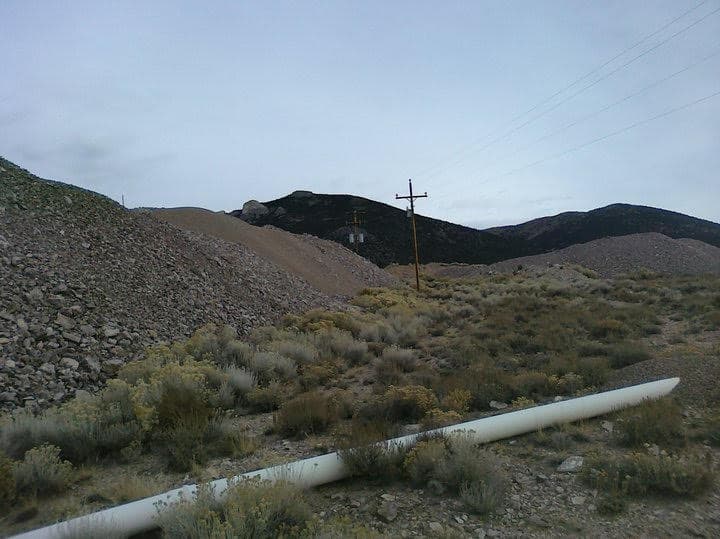
The project encompasses a portfolio of mining claims totaling 960 acres in the Osceola Mining District, located in Mary Ann Canyon on the western slope of the Snake Range. The property is situated approximately 38 miles southeast of Ely, Nevada, adjacent to U.S. Highways 6 and 50.
Elevation across the project area varies from roughly 5,800 feet in Spring Valley to over 13,000 feet at the crest of the Snake Range. Highways are generally accessible year-round, with large-scale mining operations feasible approximately 10 months per year. Annual precipitation is less than 12 inches.
Project Details
Geology
Geological Setting
Understanding the origin and distribution of gold in the Osceola District.
The Snake Range is composed of a core of pre-Cambrian metamorphic and igneous rocks flanked by Paleozoic sedimentary formations including quartzites, limestone, and shales. A post-Carboniferous granite porphyry intrudes the sedimentary section. Gold-bearing quartz veins and shear zones are found primarily in the Cambrian quartzites as sheeted zones and secondary fracture fillings.
The present topography is shaped by Basin and Range extension — parallel mountain ranges separated by valleys with alluvial fans of detrital material. The Mary Ann Canyon alluvial fan represents the accumulated erosion products of gold-bearing bedrock upstream, with heavier gold particles concentrated in ancient and modern stream channels.
Gold in the district originates from veins and shatter zones in pre-Cambrian rocks found along Mary Ann Canyon and its tributaries. Quartz vein mineralization is the primary source, with secondary fracture filling contributing additional material. Historical adit samples from above Mary Ann Canyon have returned values as high as 6 ounces per ton and 500 ounces per ton from gold-bearing, iron-oxide-stained quartz vein and shear zone material.
Gold is distributed throughout the gravels with concentrations increasing at depth. Where grades were steep and water volume sufficient, coarse gold has been concentrated in thin, high-grade strata at or near the base of the fan on bedrock or “false bedrock” of clay, caliche, or similar resistant beds. Depth to bedrock varies from 10 feet to over 100 feet across the district.
2012 Gravity Survey
Geophysical Investigation
A detailed gravity survey mapped the bedrock surface beneath the property, revealing paleo-channels and structural features that control gold deposition.
In September 2012, a comprehensive gravity survey was completed over the Mary Ann Canyon property by MaGee Geophysical Services and interpreted by James L. Wright, M.Sc. of Wright Geophysics. The survey acquired 183 unique gravity stations using LaCoste & Romberg gravity meters, with all stations precisely positioned using Real-Time Kinematic (RTK) GPS. Data quality was excellent, with a mean repeat error of just 0.0166 mGal.
The survey's primary objective was to delineate the bedrock surface beneath the pediment — the gently sloping apron of sediment between the Snake Range front and the deeper Spring Valley basin. Variations in this buried surface are critical because they control where alluvial gold has accumulated over millions of years.
The results reveal a pediment extending approximately 2.2 kilometers westward from the range front before being offset by two major basin-bounding faults that cumulatively down-drop bedrock to depths approaching 1,000 meters. Near the range front, the gravity data show considerable complexity — localized gravity highs are interpreted as blocks of basement rock protruding upward into the basin fill, separated by ancient drainage channels incised into bedrock.
These paleo-channels form a dendritic (branching) pattern draining westward from Mary Ann Canyon into Spring Valley. They represent the ancient waterways that transported and concentrated gold-bearing sediments from the source rocks upstream. The gravity survey effectively maps these buried channels, providing high-value exploration targets where gold concentrations are most likely to be found.
Survey Stations
183
Acquired Sept. 11–15, 2012
Data Quality (RMS Error)
0.021 mGal
Indicative of high-quality data
Pediment Extent
2.2 km
Westward from the range front
Basin Model Prisms
5,151
50m-spaced depth model cells
Paleo-Channel Network
Gravity lows between bedrock highs reveal a dendritic network of ancient channels incised into bedrock — the primary conduits for gold-bearing sediment transport from Mary Ann Canyon into Spring Valley.
Pediment Focus Area
The pediment zone between the range front and the basin-bounding faults is dominated by coarse, locally derived sediments and is the recommended focus for exploration efforts, as deeper basin fill may dilute placer-bearing gravels.
Recommended Next Steps
The report recommends a follow-up ground magnetic survey of approximately 90 line-km to delineate black sand (magnetite) concentrations associated with the bedrock blocks and paleo-channels, yielding specific drill-testable targets.
Mining Claims
Claim Groups
The project's 960 acres are organized into two primary claim groups within the Mary Ann Canyon alluvial fan.
MAV Claims (A, C–G)
160 acresThe most heavily sampled claim group, located in the upper alluvial fan near the mouth of Mary Ann Canyon. Samples yielded an average value of $117/yard at the original $1,000/oz benchmark. Depth to bedrock ranges from 30 to 90 feet. An estimated 5.7 to 17.3 million yards of placer material remain.
Solomon Claims (1–4)
800 acresA large contiguous claim area spanning Sections 21, 22, 23, and 24, T14N R7E, with an estimated 39 to 117 million yards of placer material depending on depth to bedrock. Limited prior mining activity — only the Solomon 3 claim has seen previous operations, with new tailings samples averaging $41.78/yard at the original benchmark.
Sampling Data
Gold Content & Assay Results
Samples from the MAV and Solomon 3 claims show consistent gold values with a clear increase in concentration at depth.
Total Average
$553.10/yd
Across current claim samples
Value Range
$85 – $2,085/yd
Low to high per yard
Gold Price Basis
$5,000/oz
Current market benchmark
| Site | Site Average | Depth Range | Value Trend ($/yd) |
|---|---|---|---|
| MAV-C Shaft | $1,542.70/yd | 10–30 ft | 895 → 2,085 |
| MAV-E Shaft | $131.75/yd | 20–40 ft | 85 → 195 |
| MAV-G Open Pit | $320.90/yd | 35–50 ft | 280 → 360 |
| MAV-G Shaft 1 | $449.00/yd | 10–50 ft | 190 → 660 |
| MAV-G Shaft 2 | $577.85/yd | 10–50 ft | 145 → 1,075 |
| MAV-G Shaft 3 | $640.60/yd | 25–40 ft | 390 → 960 |
| Solomon-3 Open Pit | $208.90/yd | 25–40 ft | 95 → 230 |
All values calculated at $5,000 per ounce of gold. Value trend shows $/yard from shallowest to deepest sample at each site, demonstrating near-linear increases in gold concentration with depth. Data sourced from Skookum Geologic Consulting Report, January 2010.
Potential Value
Reserve Estimates
Estimated gold reserves based on historical evidence from geological reports, sampling data, and the district's documented operating history.
Estimated In-Ground Gold Reserves
5,000,000+ ounces
Based on historical evidence from geological reports, sampling data, and the district's documented operating history, the company estimates over 5 million ounces of gold remain within the project's claim areas. Independent NI 43-101 compliant reports have been completed for individual claim parcels, with documentation and detailed findings to be published via press release.
MAV Claims (160 acres)
The MAV claim group has been the most extensively sampled area of the project. An estimated 5.7 to 17.3 million yards of placer material remain, with gold concentrations increasing consistently at depth. NI 43-101 compliant reports have been completed for individual MAV parcels, confirming significant resource potential.
Estimated Material Volume
5.7M – 17.3M yards
Depending on depth to bedrock (30–90 ft)
Solomon Claims (800 acres)
The Solomon claims represent the largest contiguous area within the project, spanning Sections 21–24. With limited prior mining activity, the majority of the alluvial material remains intact. Geological assessments indicate substantial gold-bearing deposits throughout the claim area.
Estimated Material Volume
39M – 117M yards
Depending on depth to bedrock (10–30 yd)
Important Note: Reserve estimates are based on historical sampling data, geological reports, and the methodology outlined by Copeland (1975), using a conservative average of 0.02 troy ounces per yard. Actual recoverable quantities may vary. Depth to bedrock is a major factor in these calculations and has not been precisely determined across all claim areas. NI 43-101 compliant technical reports have been completed for select claim parcels, with documentation available upon request.
Resources
Technical Documents & Survey Data
Access geological reports, claim maps, and sampling data for the Osceola Gold project.
Skookum Geologic Consulting Report
Summary of existing reports, assessment of recent sampling, and proposals for future work. Compiled by Gerry Griesel and Dr. Ian Mynatt, January 2010.
Mary Ann Canyon Gravity Survey & GIS Database
183-station gravity survey delineating bedrock surface, paleo-channels, and basin structure beneath the property. By James L. Wright M.Sc., Wright Geophysics, September 2012.
Claim Map — Osceola Mining District
USGS 7.5 minute Hogum Quadrangle with Kapacke Mining claim boundaries, section numbers, and sample locations.
Environmental Assessment
U.S. Department of the Interior Bureau of Land Management, Preliminary Environmental Assessment, June 2011